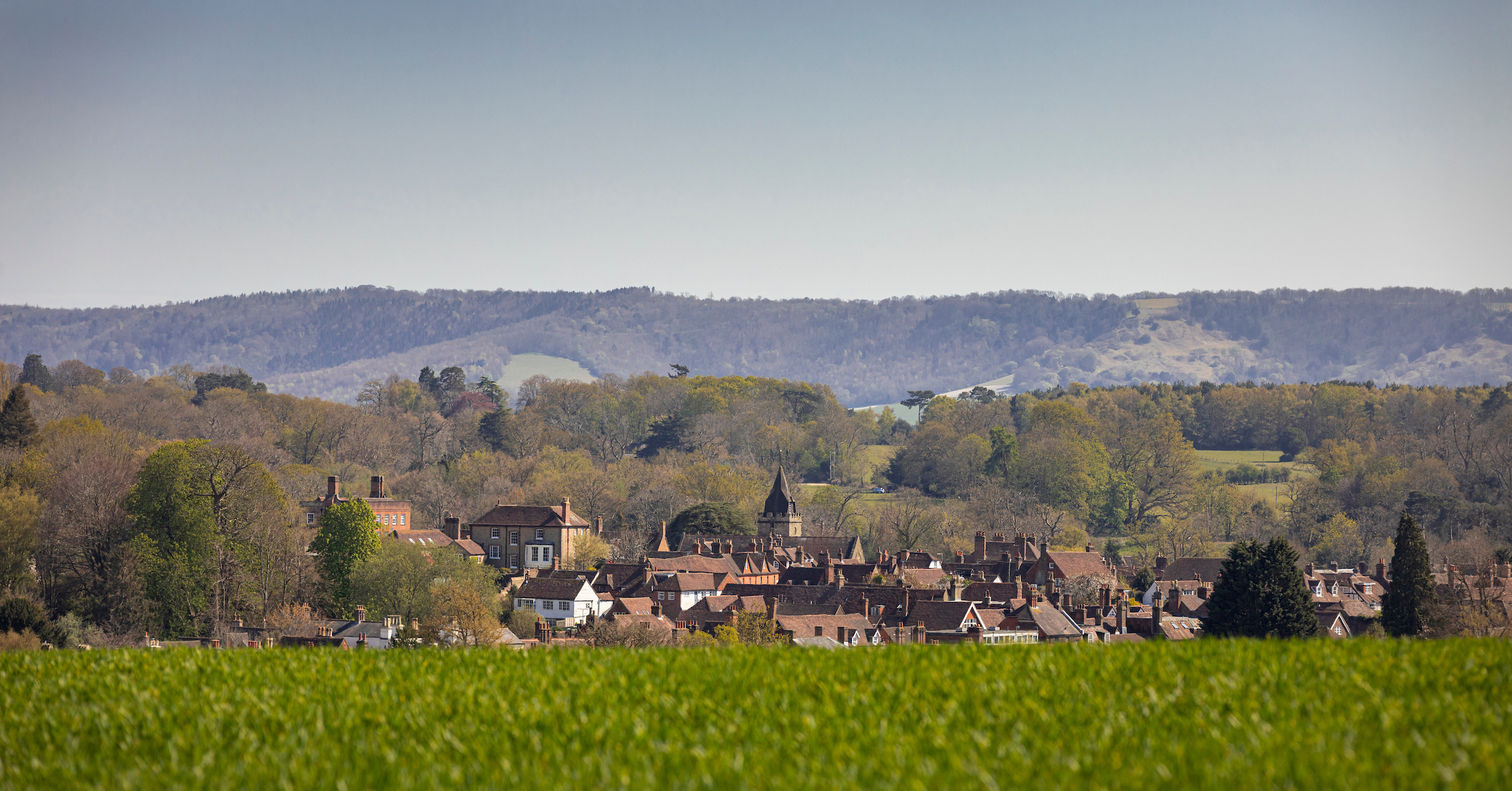


High on the South Downs near Treyford, five mysterious ancient mounds rise from the chalk grassland. Thousands of years old, they are associated with an extraordinary legend of the Devil, a furious Norse god and a supernatural confrontation.
Five Mysterious Hills
On the rolling South Downs near Treyford stands one of Sussex’s most remarkable prehistoric monuments.
Known as the Devil’s Jumps, five great grassy mounds rise in a line across the landscape.
They are not natural hills but ancient burial monuments, constructed during the Bronze Age, thousands of years before the Romans arrived in Britain.
The wider cemetery contains seven surviving barrows, although five are particularly prominent.
Yet their unusual appearance has inspired a rather different explanation.
According to local legend, these hills were once the scene of an extraordinary encounter between the Devil and Thor, the ancient Norse god of thunder.
When the Devil Came to Treyford
The story tells of the Devil amusing himself by leaping from one burial mound to another.
His enormous jumps shook the countryside, disturbing Thor, who was resting nearby on Treyford Hill.
Furious at the interruption, Thor ordered the Devil to stop.
But the Devil continued his antics, apparently delighting in the god’s irritation.
Finally, Thor seized a great stone and hurled it towards his troublesome visitor.
The missile struck its target, sending the Devil fleeing across the countryside.
According to the legend, he never returned.
The story is one of several Sussex traditions in which mysterious prehistoric monuments become associated with supernatural beings.
An Ancient Connection to the Sun
The real history of the Devil’s Jumps is arguably just as fascinating.
The five principal burial mounds form an alignment associated with the setting sun at midsummer.
This relationship has attracted considerable interest because the summer solstice was an important point in the seasonal calendar.
Whether the alignment was deliberately incorporated into the original Bronze Age design remains a matter of interpretation.
Nevertheless, it raises intriguing questions about the beliefs, ceremonies and understanding of the natural world possessed by the people who constructed these monuments.
The five great mounds have survived for thousands of years, preserving a tangible connection to Sussex’s prehistoric past.
Burial Places of the Bronze Age
Archaeologists identify the Devil’s Jumps as a round barrow cemetery.
These monuments were constructed to commemorate the dead, sometimes containing individual burials and sometimes several.
The five principal mounds are examples of bell barrows, a distinctive form of Bronze Age burial monument featuring a raised mound surrounded by a ditch and separated from it by a level platform.
Such monuments are relatively uncommon and are often associated with individuals of considerable status.
The Devil’s Jumps are protected as a Scheduled Monument, recognising their national archaeological importance.
Discover the Devil’s Jumps
The Devil’s Jumps lie on the South Downs near Treyford, within reach of Midhurst and close to the South Downs Way.
Their setting among the rolling chalk hills makes them an atmospheric destination for walkers and anyone interested in ancient history.
Visitors should remain on permitted routes, respect grazing animals and avoid disturbing the protected archaeological remains.
Standing beside these extraordinary mounds, it is easy to understand why generations of Sussex storytellers imagined supernatural forces at work.
The archaeology tells us that people gathered here thousands of years ago to honour their dead.
The legend offers a more colourful explanation.
And somewhere between the two lies the enduring mystery of the Devil’s Jumps.
Further reading: Historic England — The Devil’s Jumps and Love the South Downs — The Devil’s Jumps.