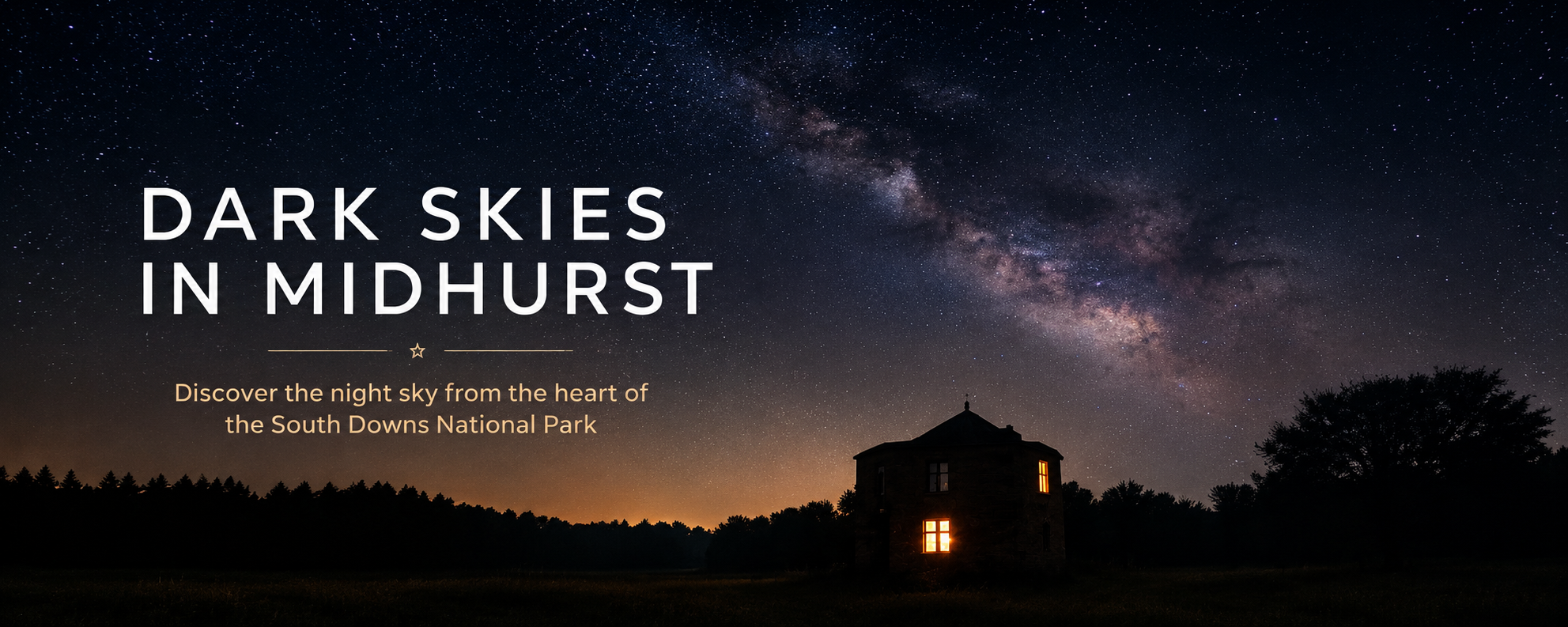


Whether you’re hoping to witness a spectacular eclipse, photograph the Milky Way or simply spend an evening under a sky full of stars, Midhurst is one of the best places in southern England to begin.
Located within the South Downs National Park, the area benefits from some of Britain’s darkest protected skies. Just a few minutes from the town centre you’ll find peaceful locations where the night sky comes alive with planets, meteor showers, constellations and the changing phases of the Moon.
Whether you’re an experienced astronomer or simply curious, we hope this guide inspires you to look up.
We recommend you explore the Best that the Dark Sky’s have to offer through the South Downs National Park Dark Skies Hub:
Dark Skies Hub – South Downs National Park Authority
The South Downs National Park also highlights several Dark Sky Discovery Sites:

Local Astronomy Events
local astronomy groups:
Further information can be found on the South Downs National Park Dark Skies Hub.
2026 Events
| Date | What to see | Rating | Why it’s interesting |
|---|---|---|---|
| 3–4 Jan | ☄️ Quadrantids | ⭐⭐⭐ | One of the year’s major meteor showers. |
| 10 Jan | 🪐 Jupiter at opposition | ⭐⭐⭐⭐ | Jupiter at its brightest and visible throughout the night (In-The-Sky.org) |
| Late Feb / 1 Mar | 🪐 Six-planet parade | ⭐⭐⭐⭐⭐ | Mercury, Venus, Saturn, Jupiter, Uranus and Neptune spread across the evening sky; four potentially naked-eye (Sky at Night Magazine) |
| 22 Apr | ☄️ Lyrids | ⭐⭐⭐ | Spring shooting stars; relatively favourable Moon in 2026 (Royal Museums Greenwich) |
| 5–6 May | ☄️ Eta Aquariids | ⭐⭐ | Halley’s Comet debris; harder from UK latitudes |
| 31 May | 🌕 Blue Moon | ⭐⭐⭐ | Second full Moon of May — excellent public-interest story (Royal Museums Greenwich) |
| 8–9 Jun | ✨ Venus & Jupiter conjunction | ⭐⭐⭐⭐⭐ | Excellent event. The two brightest planets appear roughly a finger-width apart in the evening sky (Royal Museums Greenwich) |
| 16–17 Jun | 🌙 Moon + Jupiter + Venus | ⭐⭐⭐⭐ | Lovely photographic grouping around a young Moon; the 16 June sky also featured Venus, Jupiter, Mercury and the crescent Moon (Royal Museums Greenwich) |
| June–July | ☁️ Noctilucent cloud season | ⭐⭐⭐⭐ | Glowing electric-blue/silver clouds after sunset; the UK is particularly well placed (Royal Museums Greenwich) |
| June–Aug | 🌌 Milky Way season | ⭐⭐⭐⭐⭐ | One of the best reasons to sell Midhurst’s dark skies rather than a single event; best around New Moon (Royal Museums Greenwich) |
| 30 Jul | ☄️ Delta Aquariids + Alpha Capricornids | ⭐⭐⭐ | Multiple showers; look especially for slow Capricornid fireballs |
| 12 Aug | 🌑 Major partial solar eclipse | ⭐⭐⭐⭐⭐ | Flagship 2026 event — around 90% coverage in the UK |
| 12–13 Aug | ☄️ Perseids | ⭐⭐⭐⭐⭐ | Exceptional 2026 conditions: peak around New Moon and potentially ~150/hour under ideal skies (Royal Museums Greenwich) |
| 28 Aug | 🌘 Partial lunar eclipse | ⭐⭐⭐⭐⭐ | About 90% of the Moon enters the umbra; maximum 05:12 BST. Clear SW horizon required (Royal Museums Greenwich) |
| Sep–Oct | 🌌 Autumn Milky Way | ⭐⭐⭐⭐ | Excellent photography opportunity as darker nights return |
| 9 Oct | ☄️ Draconids | ⭐⭐⭐ | Convenient evening meteor shower |
| 21–22 Oct | ☄️ Orionids | ⭐⭐⭐ | Shooting stars from debris left by Halley’s Comet |
| Nov | ☄️ Taurids | ⭐⭐⭐⭐ | Not numerous, but renowned for spectacular slow fireballs |
| 17–18 Nov | ☄️ Leonids | ⭐⭐⭐ | Famous historic meteor shower |
| 14 Dec | ☄️ Geminids | ⭐⭐⭐⭐⭐ | One of 2026’s best nights. Up to ~120/hour with the Moon setting around 9pm (Royal Museums Greenwich) |
| 24 Dec | 🌕 Christmas Eve Supermoon | ⭐⭐⭐⭐⭐ | Superb visitor/social-media story — 2026’s only supermoon (Royal Museums Greenwich) |
2027
| Date | What to see | Rating | Why it’s interesting |
|---|---|---|---|
| 3–4 Jan | ☄️ Quadrantids | ⭐⭐⭐⭐ | Major winter meteor shower |
| 3 Feb | ☄️ Comet 2P/Encke closest to Earth | ⭐⭐⭐ | Worth monitoring rather than promising naked-eye visibility; perihelion follows on 10 Feb (In-The-Sky.org) |
| 10 Feb | 🪐 Jupiter at opposition | ⭐⭐⭐⭐⭐ | Jupiter at its brightest and best placed for observing (In-The-Sky.org) |
| 19 Feb | 🔴 Mars at opposition | ⭐⭐⭐⭐⭐ | Mars at its brightest and visible through the night — just nine days after Jupiter’s opposition (In-The-Sky.org) |
| 20 Feb | 🌕 Penumbral lunar eclipse | ⭐⭐⭐ | Subtle eclipse rather than a dramatic red Moon; UK-visible (Time and Date) |
| 31 Mar | 🪐 Mars & Jupiter close approach | ⭐⭐⭐⭐⭐ | Two spectacular bright planets together — excellent public event (In-The-Sky.org) |
| 23 Apr | ☄️ Lyrids | ⭐⭐⭐ | Spring meteor shower (In-The-Sky.org) |
| 6 May | ☄️ Eta Aquariids | ⭐⭐ | Halley’s Comet debris |
| 7 May | ✨ Venus & Saturn conjunction | ⭐⭐⭐⭐ | Attractive close planetary pairing (In-The-Sky.org) |
| June–July | ☁️ Noctilucent clouds | ⭐⭐⭐⭐ | Seasonal rather than predictable — watch the northern twilight |
| June–Aug | 🌌 Milky Way season | ⭐⭐⭐⭐⭐ | Promote the best moonless weekends rather than one fixed date |
| 30 Jul | ☄️ Delta Aquariids + Alpha Capricornids | ⭐⭐⭐ | Meteor/fireball opportunity (In-The-Sky.org) |
| 2 Aug | 🌑 Partial solar eclipse | ⭐⭐⭐⭐⭐ | Total elsewhere, substantial partial eclipse from southern England (Time and Date) |
| 13 Aug | ☄️ Perseids | ⭐⭐⭐⭐⭐ | Britain’s great summer meteor shower (In-The-Sky.org) |
| 17 Aug | 🌕 Penumbral lunar eclipse | ⭐⭐ | Subtle; I’d probably mention but not heavily promote it (Time and Date) |
| 9 Oct | ☄️ Draconids | ⭐⭐⭐ | Evening shooting stars (In-The-Sky.org) |
| 17–18 Oct | 🪐 Saturn at opposition | ⭐⭐⭐⭐⭐ | Saturn at its best for the year — ideal telescope event (In-The-Sky.org) |
| 22 Oct | ☄️ Orionids | ⭐⭐⭐ | Halley’s Comet meteor shower (In-The-Sky.org) |
| 13 Nov | ☄️ Northern Taurids | ⭐⭐⭐ | Fireball potential (In-The-Sky.org) |
| 18 Nov | ☄️ Leonids | ⭐⭐⭐ | Famous November shower (In-The-Sky.org) |
| 24 Nov | ✨ Venus & Mars conjunction | ⭐⭐⭐⭐⭐ | Excellent public-facing event: two familiar bright planets together (In-The-Sky.org) |
| 13–14 Dec | ☄️ Geminids | ⭐⭐⭐⭐⭐ | Usually one of the year’s strongest meteor showers |