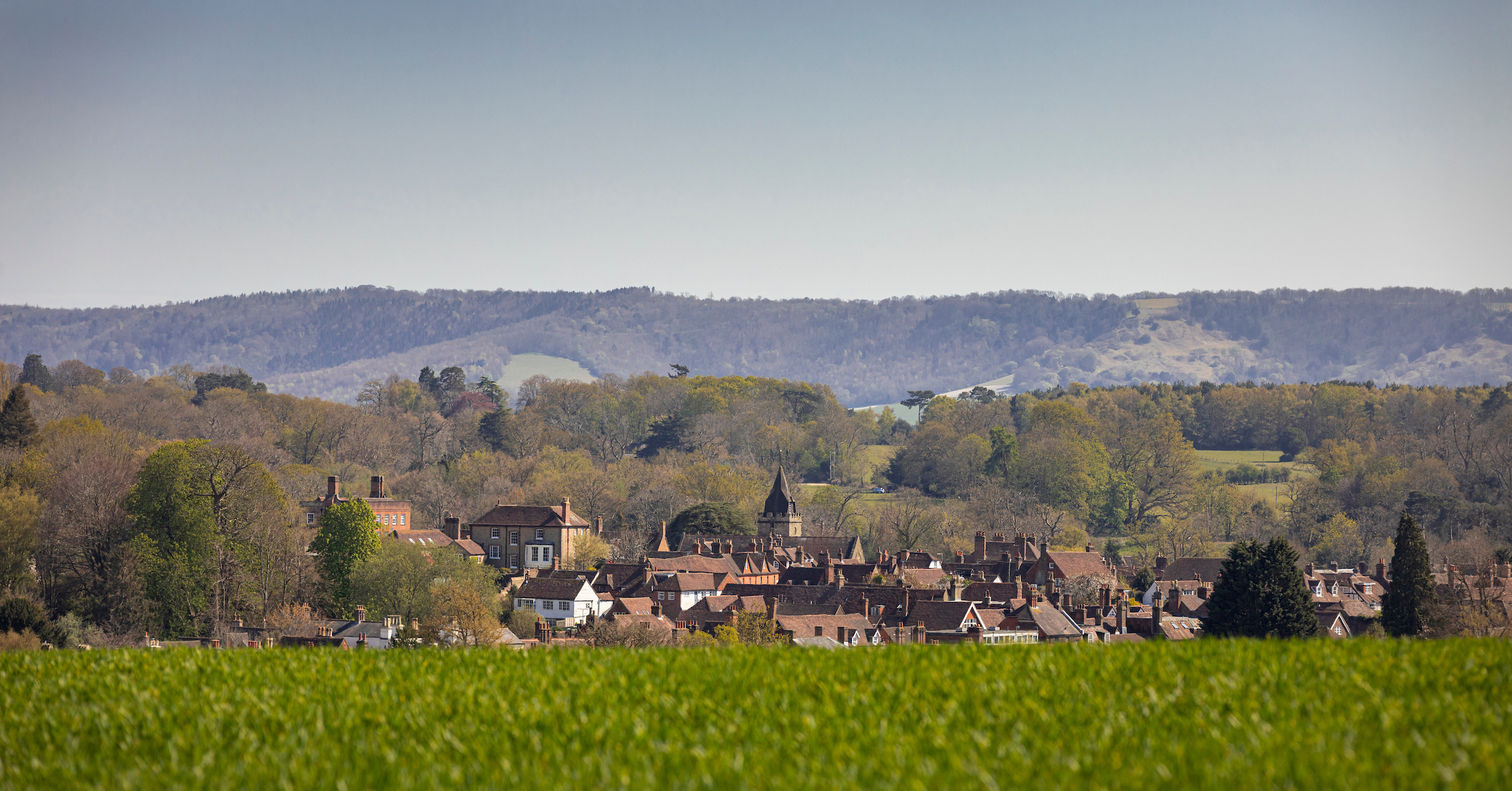



The Autumn Equinox – what exactly is an equinox??
Earth is always tilted by 23.5°, but as it travels around the Sun that tilt affects us differently. When the earth is on one side of The Sun the tilt means the Northern Hemisphere tilts towards the Sun and so Midhurst gets longer summer days. When the Earth is on the other side of the sun (6 months later) The Sun’s tilt means the Northern Hemisphere tilts away from the Sun and so Midhurst gets longer winter nights.
At the equinox, the tilt isn’t pointing towards or away from the sun and so day and night are (almost) equal.
But isn’t an equinox when day and night are equal?
Almost — and here’s the interesting bit.
The word equinox comes from the Latin for “equal night”, so you might reasonably expect exactly 12 hours of daylight and 12 hours of darkness.
It doesn’t quite work that way.
Sunrise is defined as the moment the top edge of the Sun appears above the horizon, while sunset isn’t until its top edge finally disappears. On top of that, Earth’s atmosphere bends sunlight around the horizon slightly, allowing us to see the Sun when geometrically it is actually just below it.
Both effects give us a few extra minutes of apparent daylight.
So on the equinox itself, daylight in southern England is still a little longer than 12 hours. Around London, for example, 23 September has about 12 hours 8 minutes of daylight, with the closest approach to a genuinely 12-hour day coming around 25 September.
So what does the equinox actually mark?
It’s not really a “day” at all. It’s a precise astronomical moment.
At 1:05am on Wednesday 23rd September 2026, the centre of the Sun crosses the celestial equator heading south. From then on, here in West Sussex, the Northern Hemisphere is increasingly tilted away from the Sun as we head towards the winter solstice in December.
And there’s a nice thing to look out for around Midhurst: at the equinox, wherever you have a clear horizon, the Sun rises almost due east and sets almost due west.
So tomorrow evening might be a particularly good excuse to find somewhere with a big South Downs view and watch autumn arrive.
A bit more about ‘Sunset’
Sunset is when the Sun’s upper edge disappears below the horizon.
Civil twilight lasts until the Sun’s centre is 6° below the horizon;
Nautical twilight runs from 6° to 12° below; and
Astronomical twilight from 12° to 18° below.
Once the Sun is more than 18° below the horizon, it is considered fully night. Before sunrise, exactly the same stages occur in reverse: astronomical twilight, nautical twilight, civil twilight, then sunrise.Times may vary slightly depending on your exact location.
Why doesn’t the equinox always fall on the same date?
The equinox is an exact moment in Earth’s orbit, rather than a fixed calendar date. A year is actually about 365 days and 6 hours long, so the equinox occurs roughly six hours later each year. Our leap years periodically correct this drift, moving it back again. That’s why the March equinox can fall on 19, 20 or 21 March, while the September equinox usually falls on 22 or 23 September (and very occasionally nearby dates). Your time zone can also determine which calendar date the precise moment falls on.
How unusual can the date get?
Over longer periods, the calendar produces some surprisingly rare equinox dates. In the Gregorian calendar, the March equinox can occur as early as 19 March or as late as 21 March, while the September equinox can fall on 21, 22, 23 or, exceptionally, 24 September, depending on the year and time zone. These extremes are rare because the leap-year rules continually pull our calendar back into alignment with Earth’s orbit. So although we tend to associate the autumn equinox with 22 or 23 September, over sufficiently long periods nature occasionally slips outside those familiar dates.
Which “year” are we measuring?
There is more than one way to define a year. A sidereal year—one complete orbit of Earth relative to the distant stars—is about 365 days, 6 hours, 9 minutes. But the seasons follow the tropical year, measured from one seasonal point, such as the March equinox, to the next. This is slightly shorter, averaging about 365 days, 5 hours, 49 minutes, because the direction of Earth’s axis slowly changes through precession. Our Gregorian calendar is designed to follow this seasonal or tropical year: its average length is 365.2425 days, remarkably close to the tropical year of about 365.2422 days. This is why our leap-year system keeps the equinoxes—and therefore the seasons—from gradually wandering through the calendar.
Midhurst and the South Downs International Dark Sky Reserve
Midhurst lies on the edge of the South Downs International Dark Sky Reserve.
The Reserve is:
- One of only 27 International Dark Sky Reserves worldwide.
- One of just seven in the United Kingdom.
- The closest International Dark Sky Reserve to around 17 million people living in London and the South East.
Recognised by DarkSky International, the South Downs offers some of the finest night skies in southern England. Midhurst is an ideal base for exploring this remarkable landscape after dark.
Suggested Viewing Areas
We recommend choosing any safe location with a clear western horizon.
Midhurst is surrounded by some of the Best Views.
- Iping Common: Iping and Stedham Commons easy walk – South Downs National Park Authority
- Butser Hill: Butser Hill – Go Stargazing
- Older Hill View Point: https://mapcarta.com/W4277137
- Heyshott Down: Heyshott Down, West Sussex, England – 51 Reviews, Map | AllTrails
These sites offer wide open skies and excellent opportunities to enjoy the night sky.
The South Downs National Park also highlights several Dark Sky Discovery Sites:

Local Astronomy Events
Several local astronomy organisations are available if you want to develop your understanding and experience:
Further information can be found on the South Downs National Park Dark Skies Hub.
Photography Tips
Photographing the equinox
The equinox is a great time for sunset photography because the Sun sets almost due west, making it easier to plan exactly where it will appear in your landscape.
Plan your viewpoint – because you know the Sun will set close to due west, a map or sunset-planning app can help you line it up with a favourite local landmark.
Arrive early – the best colour can begin well before sunset and continue into twilight afterwards.
Include the landscape – trees, church towers, hilltops and buildings give the setting Sun a sense of place and scale.
Look behind you – as the Sun sets, the landscape opposite can develop beautiful soft pink and purple light.
Stay after sunset – some of the richest colours often appear once the Sun has disappeared, during civil twilight.
Expose for the sky – slightly underexposing helps preserve the colour and detail around the Sun rather than washing it out.
Keep the camera steady – as twilight deepens, use a tripod or steady support and allow the shutter speed to become longer.
Try silhouettes – people, trees and familiar landmarks can look particularly striking against a bright equinox sky.
Plan Your Visit
Open the Visit Midhurst Web App: https://midhurst-events.pages.dev/ and save it to you home screen for more ideas of places to explore, eat, drink, walk and discover.