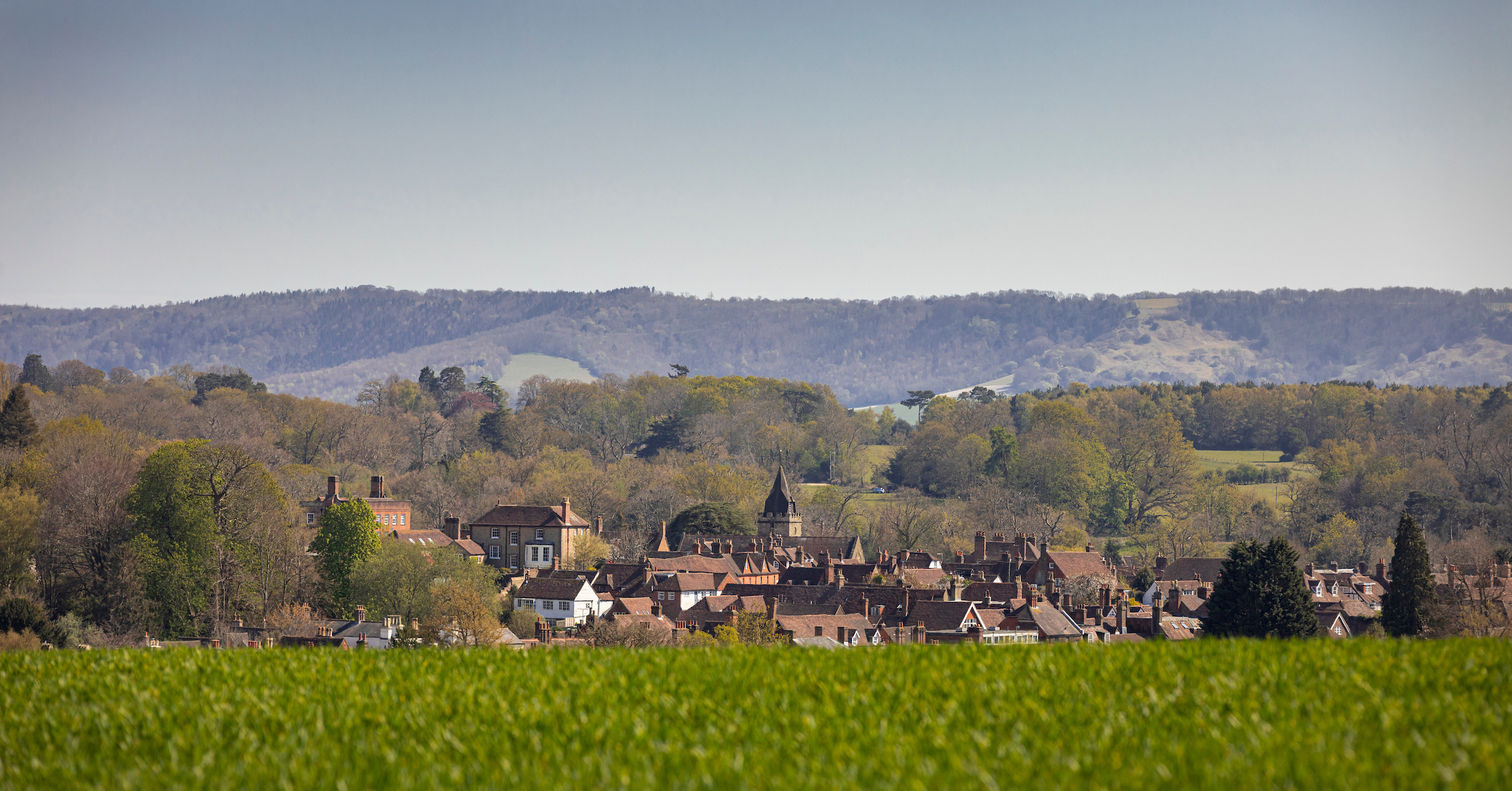


An ancient hill overlooking the River Rother, the remains of a Norman castle and whispers of forgotten pagan rituals. St Ann’s Hill holds some of Midhurst’s oldest mysteries.
Where Midhurst Began
Just a short walk from Midhurst’s historic town centre lies a wooded hill overlooking the River Rother.
Today, St Ann’s Hill is a peaceful place, its paths winding among trees and the remains of ancient stone walls. Yet centuries ago, this was one of the most important places in the surrounding landscape.
Long before Cowdray House became the seat of wealthy Tudor families, a castle stood here, watching over a river crossing and the developing settlement of Midhurst.
But could the history of this hill stretch back even further?
The Mystery of Tan Hill
According to local historical tradition, St Ann’s Hill was once known as Tan Hill.
Some have suggested that the name might be connected with Beltane, an ancient seasonal festival traditionally associated with the beginning of summer and the lighting of ceremonial fires.
Could people have gathered here to celebrate the changing seasons long before Christianity reached Sussex?
It is an intriguing possibility, but one that remains unproven.
The Midhurst Society records speculation about an earlier pagan temple on the hill, subsequently replaced by a Christian chapel.
However, there is no established archaeological evidence confirming a pagan temple or Beltane ceremonies at this particular location.
The mystery survives in the stories told about the hill rather than in confirmed archaeological discoveries.
The Castle Above the River
What we do know is that a substantial medieval stronghold occupied St Ann’s Hill.
Historic England identifies the remains as a twelfth-century castle, built on a naturally prominent site strengthened by artificial earthworks.
The castle included defensive walls, accommodation, storage buildings and a chapel dedicated to St Denis.
From this elevated position, its occupants could oversee the surrounding countryside and an important crossing of the River Rother.
The castle was eventually abandoned as the centre of local power shifted towards the site that would later become Cowdray House.
Much of its stone was subsequently removed and reused elsewhere in Midhurst.
What visitors see today is therefore only a fragment of what once stood here. Historic England
From Ancient Stronghold to Quiet Woodland
Over the centuries, the castle disappeared beneath vegetation and accumulated earth.
Archaeological investigations helped reveal the outlines of its former buildings, although some early interpretations and reconstructions are now considered uncertain.
Today, the surviving remains invite visitors to imagine a very different Midhurst.
Standing among the trees, it is possible to picture a fortified residence overlooking the valley, with the beginnings of the medieval town spreading nearby.
And beyond the documented history lies the lingering question of what, if anything, occupied this site before the Normans arrived.
A Hill of History and Mystery
St Ann’s Hill is fascinating precisely because its story is incomplete.
The medieval castle is real. Its surviving remains are protected as a Scheduled Monument.
The stories of earlier pagan ceremonies are much harder to establish.
Yet together, the archaeology, landscape and local traditions make this one of Midhurst’s most atmospheric historic places.
Perhaps the greatest mystery is not what we know about St Ann’s Hill, but what still lies undiscovered.
Discover St Ann’s Hill
St Ann’s Hill is within walking distance of Midhurst town centre.
Visitors can explore the surviving castle earthworks and enjoy a peaceful green space overlooking the surrounding landscape.
Look carefully at the remains of the medieval buildings and consider how different the town must have appeared when this hill was its principal stronghold.
Further reading: Historic England’s official monument record and The Midhurst Society’s history of St Ann’s Hill.
Visiting St Ann’s Hill
St Ann’s Hill is a short walk from Midhurst’s historic town centre. Discover the remains of its medieval castle and explore the surrounding streets, historic buildings and riverside scenery.
Explore Midhurst with the Midhurst App, your companion for finding local stories, walking routes and nearby attractions.